
PUBG's Vision: An Evolving Service, Community-Driven eSports, and Record-Breaking Legacy
PlayerUnknown's Battlegrounds revolutionized live-service games, with Brendan Greene's vision fueling PUBG's dynamic evolution and thriving eSports scene.
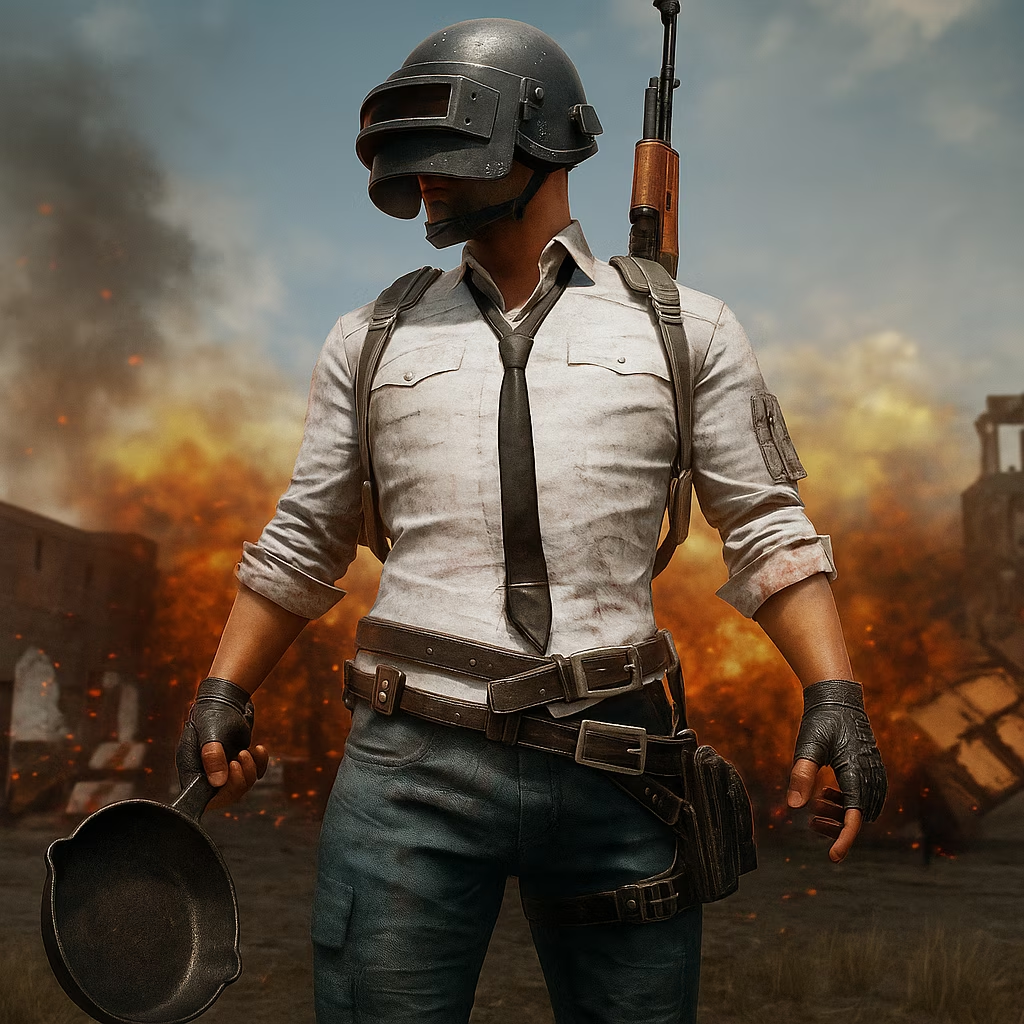 Back in 2026, looking at the colossal legacy of PlayerUnknown's Battlegrounds, it's almost funny to remember the early days. We had a chat with the man himself, Brendan "PlayerUnknown" Greene, during a TwitchCon event not too long ago, and his vision then has truly shaped the gaming landscape we see today. He never saw PUBG as just a one-and-done product; oh no, for him, it was always meant to be a living, breathing service. You buy it once, and it grows with you—polishing, refining, and adding new playgrounds over time. That idea, which seemed ambitious back then, is now the standard blueprint for live-service games. Greene's philosophy was simple: keep the core experience fresh and let the community steer the ship. It wasn't about rushing to a sequel; it was about nurturing what they had built. Talk about playing the long game!
The Service Blueprint: A Game That Never Stops Evolving
Greene's central thesis was clear: PUBG's future was as a service. "We still want to polish and refine, add more maps, add more assets," he emphasized. This wasn't just a development roadmap; it was a promise of continual renewal. Fast forward to 2026, and that promise has been kept. The game has transformed through countless updates, introducing diverse biomes, advanced weaponry, and gameplay mechanics that keep veterans and newcomers hooked. The concept of a static game is, frankly, old news. PUBG showed the industry that a title could be a platform, a hobby, a constant in players' lives that evolves seasonally. It's like that favorite pair of jeans that somehow gets more comfortable and stylish every year—you just don't throw it away.
The eSports Dream: Planted as a Mod, Blossomed by the Community
Even when PUBG was just a humble mod, Greene had a big dream tucked away. He always imagined it could become a spectacular eSport one day. The TwitchCon PUBG Omen Challenge he witnessed was the exact kind of thrilling spectacle he had hoped for. But here's the kicker: Greene never believed in forcing a competitive scene into existence. His belief was profoundly community-centric. "If a competitive scene wants to develop, it will if the community wants it," he stated. And boy, did the community want it. This hands-off, fan-fueled approach allowed organic growth. Communities formed their own rules, tournaments sprouted from grassroots efforts, and eventually, a structured, global competitive circuit emerged. It proved that the most enduring eSports aren't manufactured; they're cultivated by the passion of the players themselves. The game just had to provide the perfect sandbox.
Console Conquest and Competitive Fire
A major milestone was bringing the PC mega-hit to consoles like the Xbox One. Greene saw this not just as a port, but as an expansion of the game's soul. He believed the console community would be crucial in driving the "competitive edge" of PUBG. And he was right. Console players brought a different rhythm, new strategies, and a fierce desire to prove themselves on the global stage. The cross-play functionalities introduced later only amplified this, creating a unified, yet wonderfully diverse, battleground where PC and console tactics collided and merged. It showed that competition isn't about the hardware; it's about the heart and mind of the player behind the controller or keyboard.
Shattering Records and Defining an Era
PUBG's impact is etched in the history books with hard numbers. It blazed trails by becoming the first game ever to shatter the 2 million concurrent players barrier on Steam. That wasn't just a milestone; it was a seismic event that announced the battle royale genre as a dominant force. It demonstrated a hunger for large-scale, last-person-standing suspense that the world didn't even know it had. For players like Seth Macy, whose biggest accomplishment was an epic 8-kill first-place finish, these records translated into personal legends and unforgettable chicken dinners. The game created moments of pure, unscripted glory that players still reminisce about today.
The Legacy in 2026: More Than Just a Game
So, where does PUBG stand in 2026? It's a testament to a visionary idea executed with patience. It's a service that has weathered trends, a competitive scene born from community will, and a record-setter that expanded gaming's possibilities. Greene's early insights—focusing on service over sequel, community over coercion—feel prophetic. The game taught us that in the digital age, a title's launch is just its first breath, not its last. Its true life is in the updates, the tournaments, the shared stories of victory and defeat. It's the digital campfire around which millions gathered, and in many ways, still do. The island may have changed, but the thrill of the fight remains. Sometimes, you just have to tip your hat to a vision that saw the finish line long before anyone else even found the starting point.