
The Unseen Cracks of Glory: TaylorJay's Esports Tragedy
PUBG pro TaylorJay Johnson's tragic end exposes the silent darkness in esports and the struggles beyond a gamer's career.
I still recall the bitter August evening in 2021 when the news trickled through my social feed like a slow, toxic drip: Taylor ‘TaylorJay’ Jeffrey Johnson, a name I had followed through the tense final circles of PUBG tournaments, was dead. The headlines were brutal and surreal—a 24-year-old former pro, a five-hour police manhunt, a self-inflicted gunshot amid an attempted homicide investigation. In the five years since, that moment has remained lodged in my memory as a stark memento mori, a reminder that behind the neon-lit stages and roaring crowds, the esports world often cultivates a silent darkness that we, as fans and journalists, rarely glimpse until it’s too late.
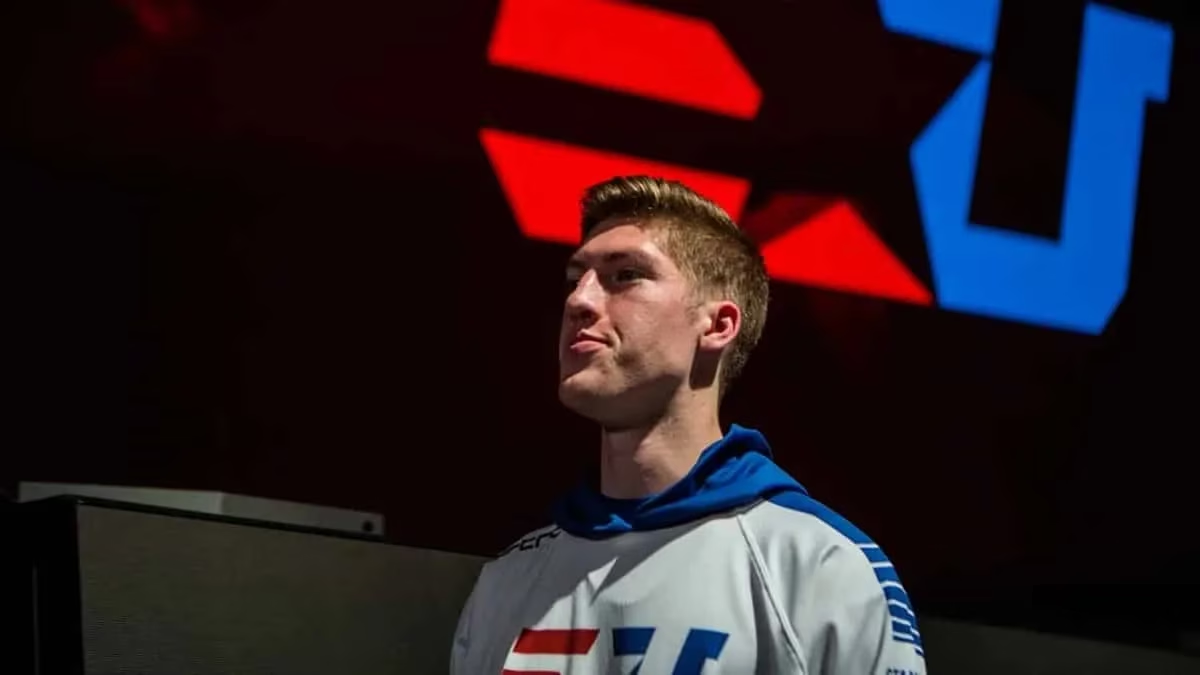
In many ways, a professional gamer’s career arc resembles a comet burning through the atmosphere: a brilliant ascent streaking across the sky, then an abrupt, often unremarked fade into the void. TaylorJay’s comet blazed from 2018 to late 2020. Over 29 months, he competed in more than two dozen events, donning the jerseys of well-known organizations like eUnited, Exodus, and Pure Gaming. Under the handle “TaylorJay,” he accumulated over $16,000 in prize money—not a king’s ransom, but a tangible validation of his skill in the hyper-competitive battle royale arena. He was known for sharp rotations and a calm demeanor in clutch situations, traits that made him a respected anchor on any team. His last professional foray was with YAHO in September 2020, after which he seemed to step out of the limelight, just another player swallowed by the relentless churn of esports rosters.
But what happens after the glow fades? We often treat the post-career phase as an invisible no man’s land that athletes must navigate alone, with the compass of their identity shattered. TaylorJay’s decline from professional player to fugitive was not a sharp cliff but a corrosive slide. Those close to the situation hinted at personal struggles that transformed the disciplined competitor into someone unrecognizable. The Pennsylvania State Police later pieced together a grim sequence: on August 26, 2021, Johnson engaged in a heated domestic altercation with a woman in her twenties, shooting her multiple times. Believing he had killed her—though she survived and was listed in stable condition after treatment—he fled North Carolina, carrying both a firearm and a suffocating weight of despair. His flight was not the calculated escape of a criminal mastermind but the panicked scramble of a man whose mental pressure cooker had finally burst its seals.
The manhunt that followed felt like a grim, real-life version of the tense endgames TaylorJay once dominated, only with no respawns. State police tracked him to Adams County, Pennsylvania, and discovered his abandoned vehicle on Route 234. For five hours, they combed the area, finally cornering him. According to trooper Megan Ammerman, as officers moved to take him into custody, Johnson turned the gun on himself. The final act was brutally efficient, leaving no room for negotiation or redemption. In the esports context, we often romanticize the “clutch” moment, but this was a tragic inversion—a man out of options, closing his own story with a single, irreversible shot.
To understand this tragedy, one must consider the insidious undertow of fame in digital arenas. Competitive gaming demands that players sacrifice their entire psychological bandwidth to maintain peak performance. The pressure acts like a silent current, constantly pulling them away from the shores of stability. Without robust mental health support and a clear off-ramp to civilian life, many drift into isolation, their personal relationships fraying into tangled threads. The domestic violence that preceded Johnson’s death is not an isolated aberration; it’s a recurring symptom of untreated stress and broken coping mechanisms that too often fester in the shadows of the spotlight.
Over the past few years, the industry has taken halting steps toward player wellness. Organizations now occasionally hire sports psychologists, and the conversation has moved beyond whispered taboos. But the echo of TaylorJay’s fall demands more than token measures. We need to dismantle the myth that retiring pros simply log off and start new lives. Their post-career journey is more akin to navigating a shipwreck in fog-bound waters, with no lighthouse in sight. The community must build that lighthouse—through financial planning, career transition programs, and mandatory mental health screenings. Only then can we honor the memory of a player whose light was extinguished far too soon.
Reflecting on all of this in 2026, I still watch old VODs of TaylorJay clutching a tense final circle with a half-broken vest and a dream. That image now serves as a bittersweet vanitas: a skull beneath the skin of our entertainment. His story is not just a cautionary tale about a fallen athlete. It’s a mirror reflecting our collective responsibility to protect the human beings behind the screens before they become headlines we regret to write.